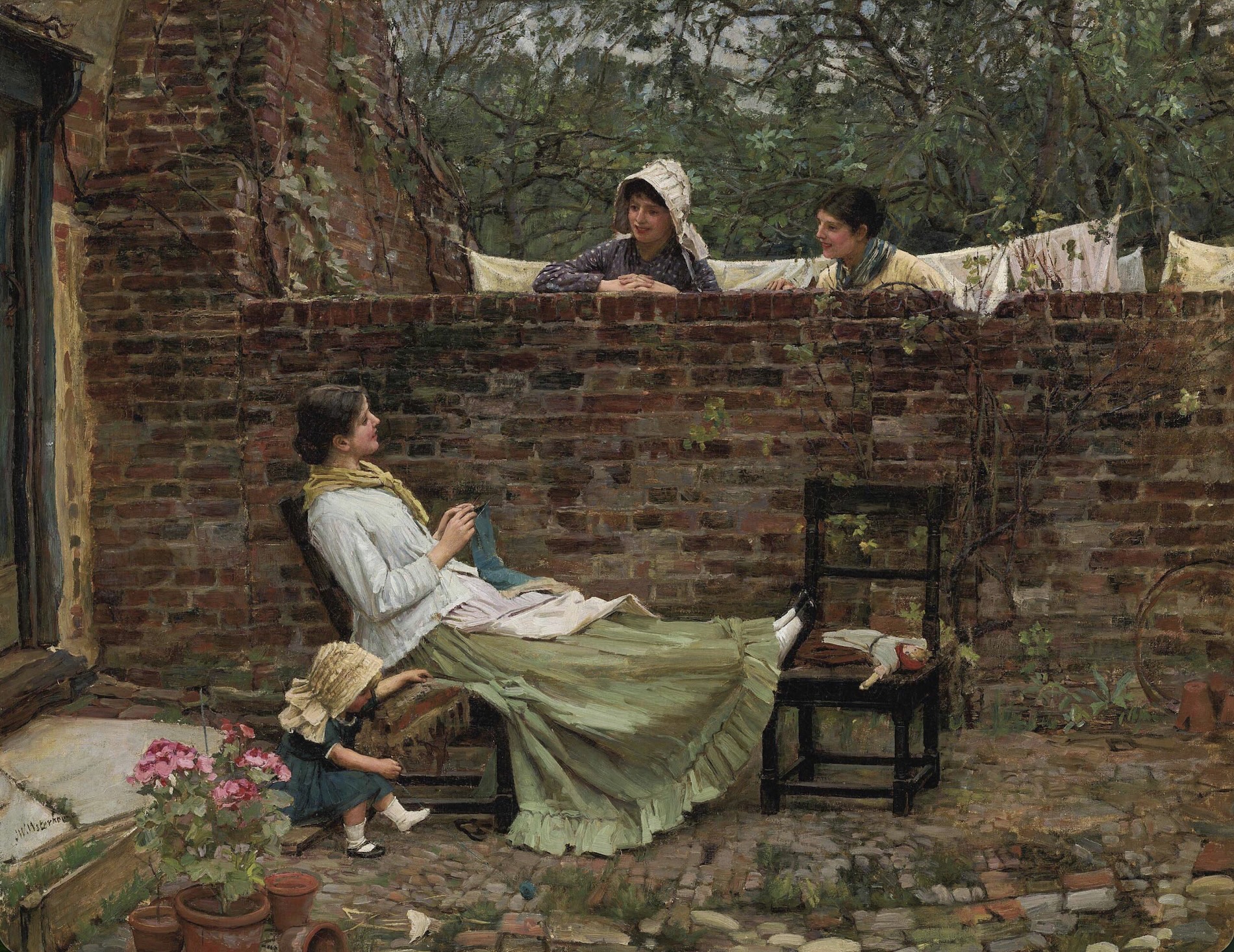
 John William Waterhouse, Good Neighbours, 1885.
§1. Aby Warburg, and later following in his steps Roberto Calasso, organised their libraries in accordance with the law of the good neighbour, according to which a text was placed next to another not because it was thematically or semantically proximal, but because following this trajectory—moving from this text to its neighbour—was enriching in some way.
The book with which one was familiar was not, in most cases, the book one needed. It was the unknown neighbour on the shelf that contained the vital information, even though one might not guess this from its title.
§1.1. To attempt to spell out the way in which traversing this arrangement could be enriching: the text that follows, that is suggested, "contain[s] the vital information," information which, when encountered at this stage—specifically, the stage following the person's encounter with the information in the preceding text—is vital—but to what?
§1.1.1. Vital, maybe, to the project at hand, the task or practice in which the person is currently engaged: researching a topic for an essay, reading for transcendence, looking for counter-examples to a theory.
§1.1.2. The trouble is that these tasks are rarely explicitly articulated; how can one expect their library to re-organise itself based on an impulse, or a vague sense of what one is trying to accomplish? One cannot, but perhaps we can make more of an effort in the cases where this intention can be well stated. In pond, we can take each thread to contain or represent a 're-arrangement of one's library.'
§2. Warburg had a single dimension along which a good neighbour could be determined, because he was placing books on a physical bookshelf, and this might seem limiting, but maybe the more relevant constraint is there is only one specific project that one can be carrying out during a traversal.
§3. We might insist that existing recommendation algorithms already implement this principle. In some sense they do, what varies is the criterion for what makes a good neighbour: in Warburg's case, it is the one that carries information vital to one's project, in something like Netflix's case, it is the one that keeps you on Netflix. These are not wholly distinct criteria, and their application may occasionally result in the suggestion of similar or identical content, but taken as design principles they result in meaningfully distinct user experiences. For instance, unlike Netflix, the Warburgian product acknowledges that its user's journey might terminate here with the neighbour containing 'vital information'.
§4. These Warburgian trails are essentially project- or task-oriented, but 'project' and 'task' here have to be carefully and expansively understood: we are concerned both with things like conducting research to resolve a specific query, and with reading or following a thread to know or understand more.
§4.1. There is on the one hand the pond user looking to understand the mutual absorption of the biological and the social in the Wittgensteinian notion of forms-of-life, and there is the one looking to bring more clearly into view a vague idea about Platonism and geometry.